Smash Car: Robot Racing
FireKulaRacing
4.284.00 Reviews
- Version
- 1.6.0
- Installs
- 10.00M
- Age Rating
- Everyone
Screenshots
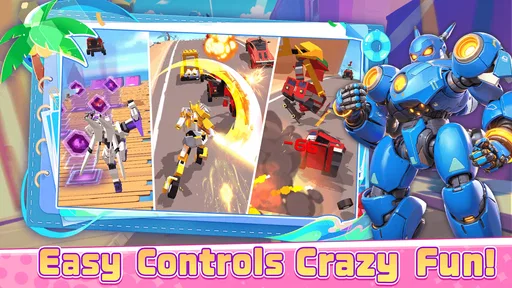
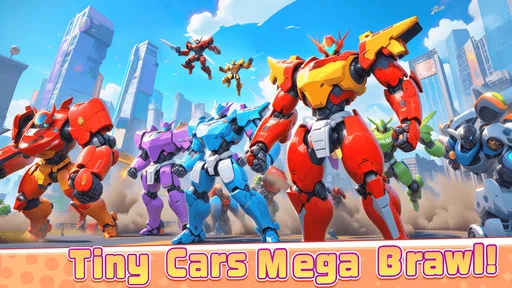
Our Review of Smash Car: Robot Racing
 Analysis by Appyee
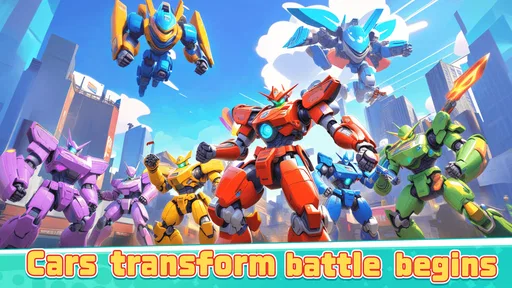
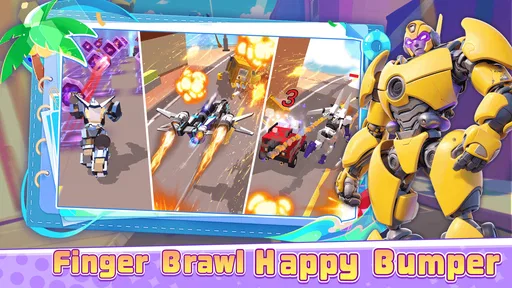
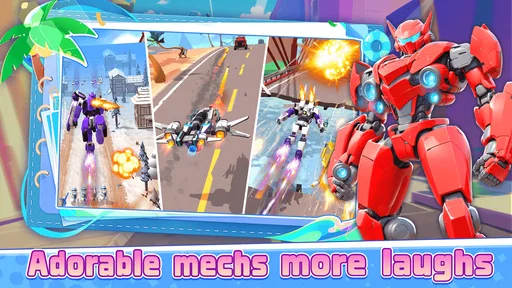
I spent time with Smash Car: Robot Racing as a quick, action-focused racing game, and my first impression was that it is less about careful lap strategy and more about turning every race into a moving collision. You drive, hit opponents, build energy, and work toward transforming into a more powerful robot form. That simple loop gives it an immediate arcade feel: you do not need a long tutorial or a patient racing mindset to understand what the game wants from you.
It is a free game from FireKula in the Racing category, with an Everyone age rating. The current version is 1.5.0, and it runs on Android 7.0 or later. Its store summary describes the central idea clearly, but the useful question is whether that idea remains entertaining after the novelty of smashing cars wears off. In my experience, the answer depends heavily on what you expect from a mobile racer.
If you want realistic handling, detailed motorsport simulation, or long strategic championships, this is not the obvious choice. If you want short bursts of cartoonish vehicle combat where attacking is just as important as driving, it has a much clearer identity than a conventional racing game. The transformation mechanic gives each run a small sense of buildup, while the free entry point makes it easy to try without committing money first.
How the racing and robot transformation work together
The most important thing to understand is that driving well is only part of the job. In a normal racer, contact with another vehicle is usually a mistake to avoid. Here, smashing enemies is part of the intended rhythm. You are encouraged to treat traffic and opponents as targets, not simply obstacles, and that changes how I approached each race.
Energy is the bridge between aggressive driving and transformation. Rather than waiting passively for a special mode, I found myself looking for opportunities to make contact and keep the action moving. That creates an interesting trade-off: taking a safer line may help you maintain control, but a more aggressive approach can charge the resource that leads to the robot state. The game therefore rewards players who can combine steering with deliberate impact.
The transformation is also what separates this experience from a basic car-smashing game. It gives the race a visible change of pace instead of leaving every moment at the same intensity. When the focus shifts from ordinary driving to robot combat, the objective feels more physical and immediate. I liked that the game does not ask me to choose between racing and fighting; it makes those two activities feed into each other.
That said, the concept is deliberately straightforward. This is not a deep vehicle simulator with a large set of technical adjustments. The appeal comes from timing, movement, and the satisfaction of building toward a stronger form. Players who enjoy learning complicated drift systems or tuning individual parts may find the experience too light. Players who prefer a clear action loop can appreciate how quickly it gets to the point.
Why energy management matters more than it first appears
A useful approach is to stop treating energy as a bonus that happens automatically. I had better results when I thought about the whole route in terms of when to attack and when to preserve control. Charging quickly can be tempting, but an uncontrolled collision may leave you badly positioned. The strongest moments come from turning attacks into a planned sequence rather than hitting anything in sight.
This makes the game more interesting during repeat sessions. On a first attempt, I naturally focused on surviving and reaching the finish. After that, I began paying attention to the order of my actions: line up a hit, recover the vehicle, build energy, and use the transformation when it can change the situation. That is a small but meaningful layer of decision-making hidden inside an accessible arcade format.
My practical tip is to avoid chasing every opponent if doing so pulls you away from the route. The game’s combat theme can make reckless pursuit feel like the correct move, but racing still matters. A hit is valuable when it supports your progress; it is less useful when it causes you to lose momentum or position. This balance is one of the better reasons to keep playing after the first few runs.
What the free entry point really means
The game is free to download and play, which lowers the risk for anyone curious about its robot-racing premise. I could judge the handling and the smash-focused loop before considering whether spending money made sense. That is important here because the concept will appeal strongly to some players and barely interest others.
There are in-app purchases ranging from $0.99 to $89.99 per item. I would therefore separate the value of free access from the value of optional purchases. The free version is enough to discover whether the driving-and-transformation cycle suits you. The presence of a high-priced purchase tier means I would not describe every possible purchase as automatically good value, especially for someone who only wants an occasional arcade distraction.
For me, the sensible approach is to play without spending at first and decide whether the core loop remains enjoyable over several sessions. A purchase can only improve the experience if it addresses a problem you genuinely have, such as wanting to progress more quickly or access something you already know you will use. Buying simply because the game creates a moment of excitement is less convincing, particularly when the available item range reaches a much higher price than the free download suggests.
This is also where the game differs from a fully premium racing title. With a paid game, the initial price usually frames the value question around the complete package. Here, the entry cost is zero, but the wider spending decision is more personal. I would recommend treating the free version as the main test and viewing every later purchase as optional value that needs to justify itself to you.
Where the experience feels strongest
The strongest part is the way the game gives ordinary driving an aggressive purpose. I did not feel as though I was merely following a track while waiting for a finish line. Every encounter could become an opportunity to charge energy, and the possibility of transforming gave collisions a reason beyond visual spectacle.
It is also well suited to short, informal play. Imagine having a few minutes before leaving home or wanting something active during a brief break. A game built around smashing, charging, and transforming is easier to pick up in that situation than a serious racing simulation that expects concentration over a longer event. I could start with a simple goal—stay moving, attack effectively, and reach the stronger form—without preparing for a complicated session.
The Everyone rating makes it easier to recommend as a broadly approachable game, although an age label does not tell you whether the style will suit every player. The action is the main attraction, and anyone looking for quiet, slow-paced driving should probably look elsewhere. The game’s personality comes from impact and motion, not relaxation.
Its audience is also reflected in its popularity. It has passed 10 million installs and holds an average rating of 4.2 from around 14 thousand ratings. Those figures suggest that the basic idea has found a substantial mobile audience, but they should not replace personal testing. A player who dislikes combat in racing games may still bounce off it immediately, regardless of how many people have installed it.
Trade-offs that become clearer with repeated play
The first trade-off is simplicity versus depth. The uncomplicated controls and direct objective make the game approachable, but they also limit how much there is to master compared with more technical racers. I enjoyed the immediacy, yet I would not choose it when I want detailed vehicle behavior, realistic circuits, or a long-term motorsport career.
The second trade-off is aggression versus consistency. Smashing enemies is central to the identity, but aggressive play can also make a run feel less controlled. Players who naturally prefer clean lines and predictable movement may need to adjust their expectations. The game asks you to accept a little disorder and use it to your advantage rather than trying to eliminate it.
The third trade-off concerns spending. Free access is a genuine advantage because it lets you try the main idea without paying first. At the same time, the in-app purchase range means the financial boundary between casual play and heavier spending deserves attention. I would be comfortable recommending the free trial experience to a friend; I would be more cautious about recommending expensive purchases without knowing exactly how often that person will play.
Another practical consideration is device compatibility. The listed minimum is Android 7.0, so people using older Android software should check their device before planning around the game. For supported phones, the important question is not whether the premise is understandable—it is—but whether the phone and player both suit quick, collision-heavy action. The game is at its best when you want something energetic rather than methodical.
Who should spend time with it
I think this is a good fit for players who enjoy arcade racing with a combat twist. If you like the idea of earning power through direct contact instead of avoiding every rival, the design has a clear appeal. It is especially suitable for someone who wants a simple mobile game that can be understood quickly but still offers a little room to improve decision-making.
It can also work for fans of transforming vehicles who want that fantasy expressed through racing rather than a traditional action game. The robot form is not just a decorative label in the premise; it gives the race a goal and changes the feeling of the run. That makes the game more distinctive than a generic endless driving title where the only objective is to continue moving.
I would suggest it to a friend who often plays in short sessions and does not want to learn a complex control system. The free price makes the recommendation easy: install it, try the core driving, and decide whether the impact-and-energy loop feels satisfying. There is no need to treat it as a replacement for every other racer. It fills a narrower role, and it does that role best when you want immediate action.
I would skip it if your favorite racing games are built around realistic braking, careful cornering, licensed cars, or deep tuning. I would also skip it if you dislike the idea of spending time colliding with opponents. The game’s central appeal is not a side activity that can be ignored; it shapes the entire experience. A conventional racer will be a better choice for someone who sees contact as failure rather than progress.
How it compares with more familiar mobile racers
Compared with a standard arcade racer, this game places more emphasis on attack timing and transformation buildup. In a typical alternative, the main satisfaction comes from overtaking, drifting, or maintaining speed. Here, those skills are joined by the question of when to hit an enemy and how that action contributes to energy. That makes the race feel more like a compact vehicle battle than a pure contest of lap time.
Compared with a combat-focused driving game, it keeps the racing structure more visible. You are not simply roaming around looking for targets; movement and progress still matter. That combination is its most useful point of difference. It is not as serious as a simulator and not as purely destructive as a demolition game, sitting between those styles with transformation as its hook.
Compared with a premium mobile racer, its advantage is the ability to try the concept at no download cost. Its disadvantage is that the purchase system requires more restraint from players who want to keep spending predictable. I would choose a paid alternative when I wanted a clearly defined one-time purchase and a more traditional racing package. I would choose this one when I wanted to test an unusual idea quickly and play in short bursts.
My verdict on value
After playing it, I see Smash Car: Robot Racing as a focused arcade game rather than an all-purpose racing solution. Its value comes from a specific loop: drive into the action, build energy through aggressive play, and use transformation to make the race feel stronger and more dramatic. That loop is easy to understand, but the best runs require more judgment than the simple premise initially suggests.
The free access is the clearest reason to try it. You can find out whether the controls, collisions, and transformation idea work for you before considering any purchase. Because individual in-app items can cost from $0.99 up to $89.99, I would keep spending deliberate and avoid assuming that a more expensive option automatically provides better personal value.
My final recommendation is positive but specific: download it if you want fast, accessible racing built around smashing opponents and becoming a robot. Give it a pass if you want realism, deep tuning, or a predictable premium purchase. For the right player, the game turns a familiar racing format into a lively combat loop, and its free starting point makes that experiment worth trying.
FireKula has given the game a clear personality instead of making another anonymous car racer. The concept may not satisfy everyone, and its purchase structure deserves sensible limits, but the central idea is strong enough to carry several enjoyable sessions. I would recommend starting free, learning to attack without losing control, and deciding on any spending only after the transformation mechanic has earned your attention.
Privacy and Permissions
See what permissions an app requests and how it handles your data.
- Wi-Fi connection information
- view Wi-Fi connections
- Other
- view network connections, full network access, control vibration, prevent device from sleeping, Google Play license check
Verdict
Strengths of Smash Car: Robot Racing
- Fast-paced races are easy to pick up, even for casual players.
- Robot-themed cars give the game a distinctive visual identity.
- Short events fit well into quick gaming sessions.
- Simple controls work comfortably on touchscreen devices.
- Unlockable vehicles add a clear sense of progression.
Limitations of Smash Car: Robot Racing
- Repeated tracks can make the racing experience feel predictable.
- Some upgrades may require considerable grinding to obtain.
- Visual effects can become distracting during crowded races.
- The game may appeal less to players seeking realistic driving physics.
- Performance can vary on older phones during intense action.
Similar Picks in This Category
View All
Hill Climb Racing
Fingersoft4.3

Dr. Driving
SUD Inc.4.2

Traffic Rider
skgames4.5

Asphalt 8 - Car Racing Game
Gameloft SE4.6

Race Master 3D: Car Racing
Beresnev Games4.6

Extreme Car Driving Simulator
AxesInMotion Racing4.3
Frequently Asked Questions
What is Smash Car: Robot Racing?
Smash Car: Robot Racing is an action-focused racing game that combines fast driving with robot-themed combat and destructive challenges. Instead of simply completing clean laps, you generally need to control a powerful vehicle, avoid hazards, crash through obstacles, and compete in energetic environments. Its appeal comes from mixing arcade racing mechanics with smashing and battling, making it more suitable for players who enjoy short, chaotic sessions than realistic motorsport simulation.
How do you play Smash Car: Robot Racing?
The game is designed around straightforward mobile controls, so new players can usually begin driving quickly without learning complicated racing techniques. Your main objectives are to steer effectively, maintain speed, overcome obstacles, and use the vehicle’s destructive abilities at the right moment. Depending on the level or challenge, success may require reaching the finish line, defeating opponents, surviving hazards, or causing enough destruction to complete the mission.
Can Smash Car: Robot Racing be played offline?
Smash Car: Robot Racing may support offline play for some of its core racing or challenge content, which is useful when you are travelling or do not have a reliable internet connection. However, certain features can still require connectivity, including advertisements, online services, updates, purchases, leaderboards, or other account-related functions. It is best to launch the game once while connected and check which modes remain available before relying on it offline.
Is Smash Car: Robot Racing free to download?
The game is generally presented as a free-to-download mobile title, allowing players to install it and try the main gameplay without paying an upfront purchase price. Like many free games, it may include advertising, optional in-app purchases, or upgrade systems that can affect progression and customization. Before downloading, review the store listing for current pricing, supported devices, in-app purchase details, and the permissions requested by the latest version.
Is Smash Car: Robot Racing suitable for children?
Smash Car: Robot Racing can be accessible to younger players because its controls and arcade-style objectives are relatively easy to understand. Nevertheless, parents should check the official age rating and review the game’s advertising, in-app purchases, and privacy information before allowing children to play. The crashing and robot-combat theme may not appeal to every family, and younger users could accidentally interact with adverts or purchase options without supervision.
Play our best games!


